Digital Detox Cabin Packing List: The Best Analog Gear for an Off-Grid Weekend
Isle Theory Editorial Team
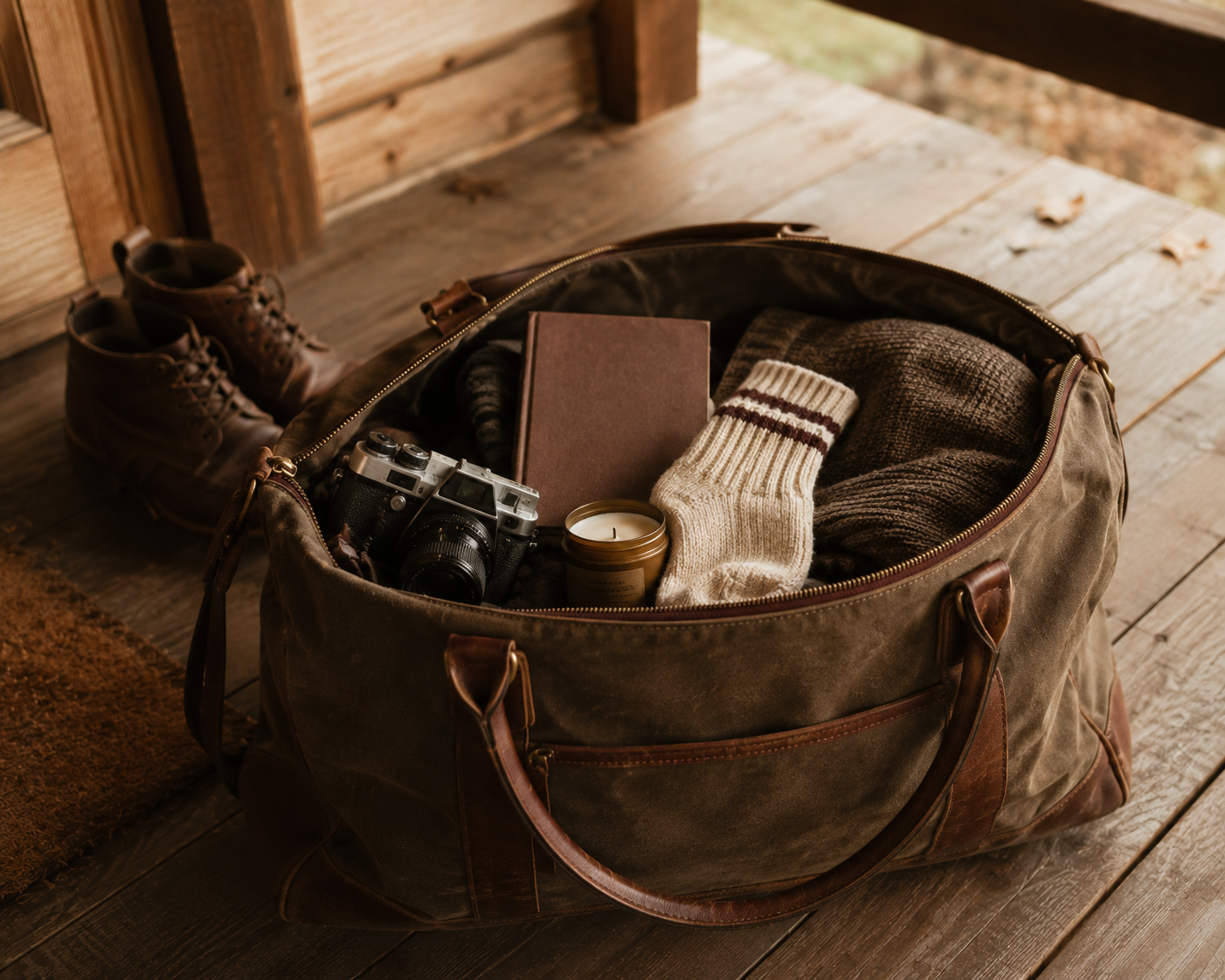
A good digital detox cabin packing list has one job: get you through a weekend without reaching for a charger you didn’t bring. That’s a harder brief than it sounds. Most “unplug” packing guides quietly smuggle a battery pack in at the bottom of the list, which sort of defeats the point — you can’t leave your phone dead in a drawer if you’ve also packed the thing that keeps it alive. This list doesn’t do that. Everything below is chosen because it works with no outlet, no signal, and no app, and because it’s genuinely good at its job once you’re actually there.
We split it into five categories: what keeps your hands busy, what lets you capture the trip without a phone, what you’ll actually write in, what gets you through the dark hours, and what makes the mornings worth getting up for. There’s also a section on what we left off on purpose, because that’s arguably the more useful part of a list like this.
Something to Do With Your Hands
The first hour or two of a screen-free weekend is the hardest, and it’s almost never the sleeping or the hiking that trips people up — it’s the in-between moments. Waiting for coffee to brew. Sitting on a porch after dinner with nothing scheduled. That’s exactly when a phone gets picked up out of habit, not need, so it helps to have something else within reach.
A deck of cards or a compact card game earns its spot here more than almost anything else on this list, mostly because it scales. Two people, four people, a whole cabin full — it works the same way. Monopoly Deal is a strong pick for a group of two to five: it’s the card version of the board game, plays in about fifteen minutes a round, and doesn’t require a table big enough for a full board.
For solo trips or quieter evenings, we’d point to actual books over anything else on this list. Two we keep coming back to for a cabin weekend: One Man’s Wilderness, Sam Keith’s account (built from Dick Proenneke’s own journals) of a man who left his job at fifty to build a cabin alone in Alaska — slow, quiet, and genuinely absorbing if you’re in the right mood for it. On the other end, A Walk in the Woods is Bill Bryson’s much funnier, much less solitary account of attempting the Appalachian Trail, better suited to reading out loud bits to whoever else is in the room.
Monopoly Deal
The card version of the classic board game — fast rounds, works for two to five players, no table required.
One Man's Wilderness: An Alaskan Odyssey — Sam Keith
Sam Keith’s account, built from Dick Proenneke’s own journals, of building and living alone in a hand-built Alaskan cabin
A Walk in the Woods — Bill Bryson
Bryson’s funny, well-loved account of attempting to hike the Appalachian Trail.
Capturing the Weekend Without Your Phone
The instinct to document a trip doesn’t go away just because the phone is locked in the car. It just needs a different outlet. An instant camera solves this cleanly — you get a physical photo in your hand within a couple of minutes, no app, no cloud, no scrolling back through a camera roll later.
The Fujifilm Instax Mini 12 is the simplest version of this that’s still genuinely good. Twist the lens, point, shoot — there’s a built-in selfie mode with a small mirror for framing, and automatic exposure so you’re not fussing with settings in low porch light. It’s worth noting this is intentionally the more basic Instax model rather than the newer hybrid ones, which let you review and reprint through a phone app — that’s a fine camera on its own terms, just not the point of this list.
Fujifilm Instax Mini 12 Instant Camera
A simple, analog-feeling instant camera with automatic exposure and a built-in selfie mirror.
Somewhere to Actually Write Things Down
This is the item that tends to surprise people the most once they’re there — a notebook does a lot more work on an off-grid weekend than it does at home, because it absorbs everything a phone would normally catch. Grocery lists for the next trip. A half-formed thought at 11pm. A sketch of the view from the dock.
A Moleskine Classic hardcover notebook is a reliable, unfussy choice here — thick, acid-free pages that hold up to a ballpoint or a fountain pen, an elastic closure so it survives being tossed in a bag, and a back pocket for anything you want to tuck inside. It’s not trying to be clever. It just works every time you open it.
Moleskine Classic Hardcover Notebook, Large, Ruled
Acid-free ivory pages, elastic closure, expandable back pocket — a reliable everyday journal.
Light After Dark (Without a Cord)
Most cabins have some form of lighting, but it’s rarely enough for reading in bed, finding your shoes at 2am, or walking to the car after dark — and a phone flashlight burns through the one battery you’re trying to leave alone. A dedicated headlamp is the fix, and it’s worth choosing a battery-powered one over a USB-rechargeable model for this specific trip, since that keeps a charging cable out of your bag entirely.
The Black Diamond Astro 300 is a solid, no-frills pick — AAA battery powered, 300 lumens, with dimming and strobe modes, and it runs roughly 140 hours on its lowest setting. It’s built for exactly this kind of general around-camp use rather than technical night hiking, which is really all a weekend like this calls for.
Black Diamond Astro 300 Headlamp
AAA battery powered, 300 lumens, dimming and strobe modes — no cord, no charging.
Coffee Worth Getting Up For
Mornings without a phone tend to move slower, which is more or less the entire point — and a good cup of coffee made without an electric machine fits that pace better than a pod system ever could. A portable French press handles this without needing power of any kind.
The ESPRO P0 Ultralight is a double-walled, vacuum-insulated stainless steel press that holds heat well past the first cup, which matters when breakfast is unhurried. It’s built to travel — light enough to toss in a bag, tough enough that it isn’t precious about how it’s packed.
ESPRO P0 Ultralight Travel French Press, 16oz
Double-walled, vacuum-insulated stainless steel — no power source needed.
What We Left Off This List on Purpose
Most digital detox packing guides include a portable battery bank somewhere near the bottom, usually with a line about “keeping your phone charged for emergencies.” We thought about it and decided against including one here, and it’s worth explaining why.
The entire premise of this list is that nothing in your bag needs a charge. A battery bank quietly works against that — it’s hard to fully unplug from a device you know you can keep alive all weekend. If a genuine emergency-only phone matters to your specific trip (a remote road, patchy cell service, a medical consideration), that’s a reasonable call to make for your own situation — just worth keeping separate from the “detox” gear itself rather than folded into it. For the purposes of this list, we kept things fully analog.
FAQ
What should go on a digital detox cabin packing list?
The short version: analog entertainment (cards, books, a journal), a way to capture the trip that isn’t your phone (an instant camera works well), and comfort gear that doesn’t need charging — a battery-powered headlamp and a non-electric coffee maker cover most of it. A genuinely useful digital detox cabin packing list avoids anything that quietly depends on a plug.
Do I need to bring my phone at all?
That’s a personal call based on the specific trip — cell coverage, how remote the cabin is, and whether anyone needs to reach you. Some people lock the phone in the car for the whole stay; others keep it off but accessible for emergencies. Either approach works as long as it’s decided ahead of time rather than negotiated moment to moment once you’re there.
Is a weekend really long enough for a digital detox to do anything?
There’s no fixed rule for this, and how noticeable the effect is tends to vary quite a bit person to person. A couple of days without a screen is generally enough to at least break the habit of reaching for one, even if it’s not a long-term shift on its own.
What if I get bored without my phone?
That’s what the entertainment section above is for — cards, a couple of good books, a journal. Most people who bring one or two of those find the boredom passes faster than expected, since it’s usually the first hour that’s hardest, not the whole weekend.
Isle Theory Editorial Team
We research and select every product featured on Isle Theory. Our recommendations reflect independent editorial judgment, not paid placement.

Read Next
A weekly edit of beauty, style, and the good life.
No spam. Unsubscribe anytime.