How to Buy Vintage Furniture Online: 5 Genuine Ways to Shop With Confidence
Isle Theory Editorial Team
If you’ve ever typed how to buy vintage furniture online into a search bar at midnight, then closed twenty tabs an hour later without buying anything, the problem probably wasn’t a lack of options. It was not knowing what actually separates a genuine find from an expensive mistake. Vintage and antique marketplaces are enormous, the photos are flattering by design, and a piece that looks perfect on your screen can turn out to be the wrong size, the wrong material, or simply not what the listing implied.
None of that means you should stick to flat-pack. It means shopping vintage online rewards a little bit of method — five habits, really, that turn a hopeful scroll into a piece you’ll actually keep.
This guide walks through exactly that: how to check a piece’s real story before you buy it, how to measure so nothing shows up too big for the doorway, where the three marketplaces we trust actually differ, how to read a condition report like someone who’s done this before, and how a single well-chosen vintage piece settles into a room you’ve already built. None of it requires becoming an antiques expert. It requires five specific things to check, in order, every time.
Check the Story First: Authenticity, Maker's Marks & Construction
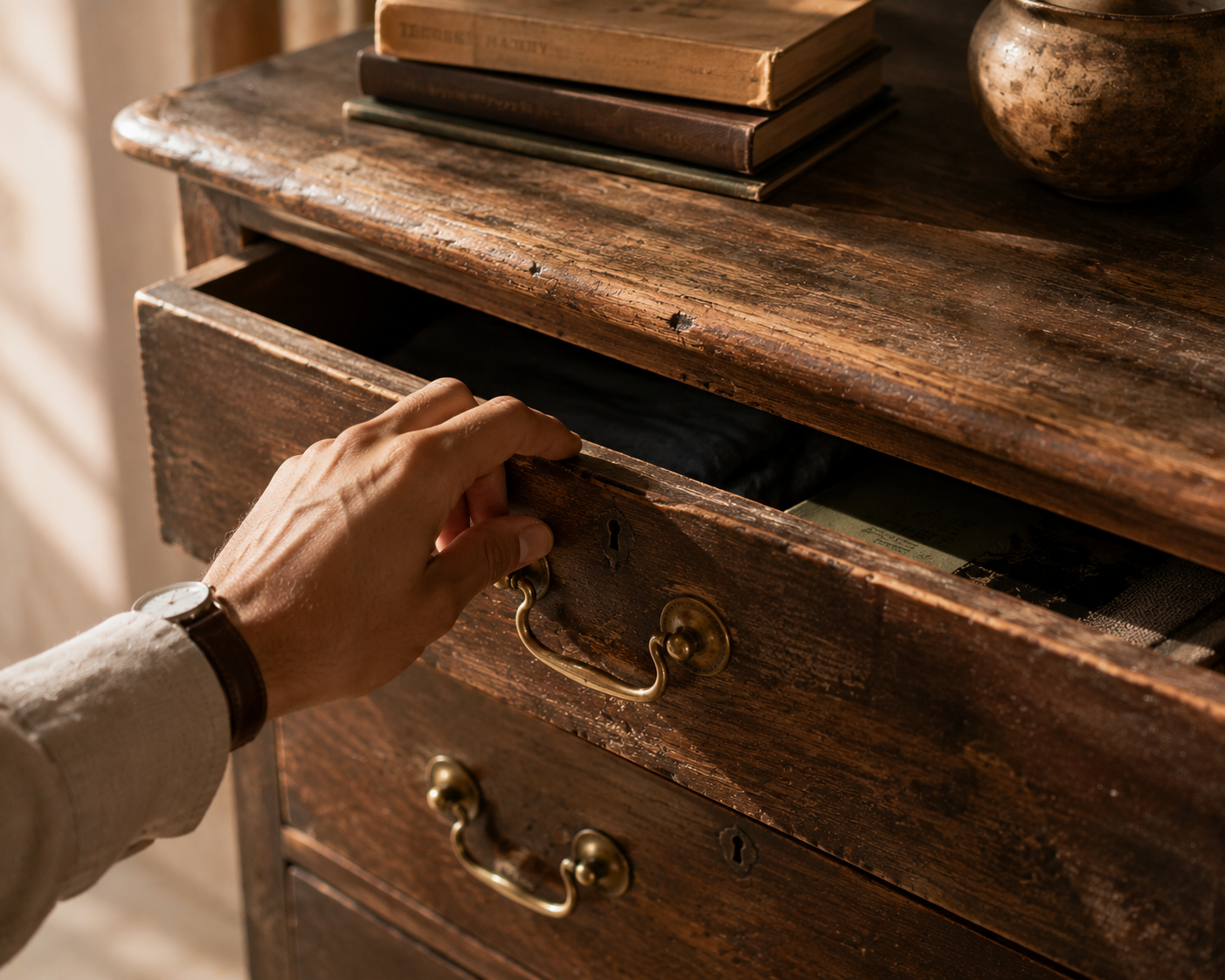
The first real skill in how to buy vintage furniture online is knowing what evidence to look for. Every genuinely old piece of furniture has signs of how it was made, and that evidence is usually visible in photos if you know where to look. Start with the joinery — dovetail joints, mortise-and-tenon construction, and hand-planed surfaces with slight, human irregularities are all signs of pre-industrial or early-industrial construction, while perfectly uniform edges and visible staple guns usually mean something newer.
Look for a maker’s mark, a manufacturer’s label, or a stamped date on the underside of a drawer or the back of a case piece — sellers on Chairish, 1stDibs, and Etsy will usually photograph this if it exists, and it’s fair to ask a seller directly for a photo of it if the listing doesn’t include one.
Solid wood versus veneer is the other question worth settling before you buy. A thin sliver of contrasting wood at a drawer’s edge, or a slightly different grain direction on the top of a piece versus its sides, usually signals veneer over a substrate — not necessarily a dealbreaker, since well-executed vintage veneer work can be beautiful and durable, but you want to know which you’re buying. Design writer Kate Watson-Smyth’s practical rundown of what to check before buying vintage — maker’s marks, “style of” language in a listing, and getting the size right — is a genuinely useful gut-check if you want a second opinion on a specific piece before committing.
Measure Before You Fall in Love
This is the single most common regret in buying furniture online, vintage or otherwise, and it’s completely avoidable — and honestly, the step people skip most when they’re first figuring out how to buy vintage furniture online. Before you save a listing, measure the actual space it needs to live in — not just the wall length, but the path it has to travel to get there.
Doorways, stairwell turns, elevator interiors, and hallway corners are where an otherwise perfect piece gets stuck, sometimes literally. Measure your own doorway width and diagonal clearance, not just the piece’s dimensions in the listing.
Then measure the piece itself against how you’ll actually use it — a coffee table needs enough clearance from a sofa to walk around comfortably, a dining chair needs to tuck fully under the table, a dresser needs drawer-pull clearance from a nearby wall or door swing. Every listing on Chairish, 1stDibs, and Etsy includes dimensions; the habit that matters is actually checking them against your space with a tape measure before you buy, not after the piece arrives.
Choose Your Marketplace: Chairish, 1stDibs & Etsy
The three platforms worth knowing serve genuinely different purposes, and picking the right one for what you’re after saves time.
Chairish is the most approachable of the three for everyday vintage and secondhand furniture across a wide range of styles and price points, with a “Make an Offer” feature that lets you negotiate directly with sellers — useful if you’re patient and price-sensitive. 1stDibs leans toward higher-end, gallery-quality antiques and design-period pieces, with a stronger concentration of rare and investment-grade finds, generally at a higher price point than Chairish.
Etsy is the most accessible on price and the most directly aligned with a “furniture with a story” mindset, since many of its vintage sellers are small, independent dealers rather than large curated marketplaces — it’s also the best of the three for handmade and artisan-made pieces specifically, not just vintage ones.
There’s a real sustainability case for buying vintage over new, beyond the design appeal. According to the U.S. Environmental Protection Agency’s own tracking of municipal solid waste, furniture and furnishings generated in the U.S. reached roughly 12 million tons in a recent full accounting year, and the large majority of that ends up landfilled rather than recycled or reused. Buying a piece that already exists, instead of one built to be replaced in a few years, is a small but real way to sit on the other side of that number.
Read the Condition Report Like You Mean It
Vintage listings almost always include a condition note, and it’s worth reading as carefully as the price. “Signs of wear consistent with age” is normal and often part of the appeal — it’s not the same thing as structural damage. What actually matters: check for stability (does the piece wobble or rock in photos or in a seller’s description of it), and check upholstery separately from the frame underneath it, since fabric can always be replaced but a compromised frame is a bigger commitment.
Check for repairs that were done well versus repairs that were done cheaply, too — a competently re-glued joint is completely different from a visible crack held together with hardware store brackets. Reading past the flattering photo angle to what a piece actually needs is most of what separates a confident buyer from someone learning how to buy vintage furniture online the hard way.
If a listing photo shows a piece from only one or two angles, or the condition description is vague, it’s completely reasonable to message the seller and ask for more photos or specifics before buying — every one of the three marketplaces above supports direct seller messaging, and a seller who won’t answer a specific condition question is useful information in itself.
Let It Live With What You Already Own
The best vintage pieces don’t read as a themed “vintage room” — they read as one interesting, well-chosen object living comfortably among things that aren’t vintage at all. Knowing how to buy vintage furniture online is really only half the job; the other half is what you do with the piece once it arrives.
A single vintage side table next to a plain, modern sofa does more for a room than five vintage pieces crowded together trying to make a point. Let the piece you bought be the one thing in the room with real history, and keep everything around it simple enough that the story has room to be noticed.
This is also where the “with a story” framing earns its keep practically, not just aesthetically: a piece with visible age, a maker’s mark, or an honest repair reads as intentional next to newer furniture in a way that a brand-new piece trying to look aged never quite manages.
The Short Version: How to Buy Vintage Furniture Online With Confidence
Check the story before you check out. Measure the space and the piece against each other, not just against the listing photo. Pick the marketplace that matches what you’re after — Chairish for range and negotiation, 1stDibs for higher-end and design-period pieces, Etsy for accessible prices and independent sellers.
Read the condition report the way you’d read a used car listing. And let one well-chosen piece do the work instead of crowding the room with five half-committed ones. That’s genuinely all it takes to learn how to buy vintage furniture online without the guesswork — the rest is just doing it enough times that it becomes second nature.
If this whole approach — one good piece, chosen carefully, over a room full of matching new furniture — sounds like a philosophy as much as a shopping method, it is. Our piece on building a collected-not-decorated home on a real budget goes deeper into that mindset, beyond just where to buy the furniture itself.
FAQ
Is it safe to buy vintage furniture online without seeing it in person?
Yes, as long as you follow the same habits you’d use in person: check the maker’s marks and construction details in photos, read the condition report closely, measure everything against your own space, and message the seller directly with any questions before buying. This is really the whole method behind how to buy vintage furniture online with confidence — none of it requires being in the room with the piece.
What's the difference between "vintage" and "antique" furniture?
“Antique” generally refers to pieces at least 100 years old, while “vintage” usually covers pieces that are older but not yet antique — commonly a few decades old, often mid-century or later. Marketplace listings use both terms, so checking the actual construction and any dated maker’s mark matters more than the label a seller chooses.
Is vintage furniture actually more sustainable than buying new?
Generally, yes — and it’s part of why so many people start looking into how to buy vintage furniture online in the first place: buying a piece that already exists avoids the manufacturing footprint of a new one and keeps a usable object out of the waste stream, where furniture is disposed of at a notably high rate compared with other household categories.
Do I need to know a lot about antiques to shop vintage furniture online successfully?
No. The five checks in this guide — authenticity and construction, measuring, choosing the right marketplace, reading the condition report, and styling the piece simply once it arrives — cover what actually matters. Expertise helps with rare, high-value pieces, but for most everyday vintage buying, a careful, methodical approach gets you most of the way there.
Isle Theory Editorial Team
We research and select every product featured on Isle Theory. Our recommendations reflect independent editorial judgment, not paid placement.