Isle Theory Editorial Team
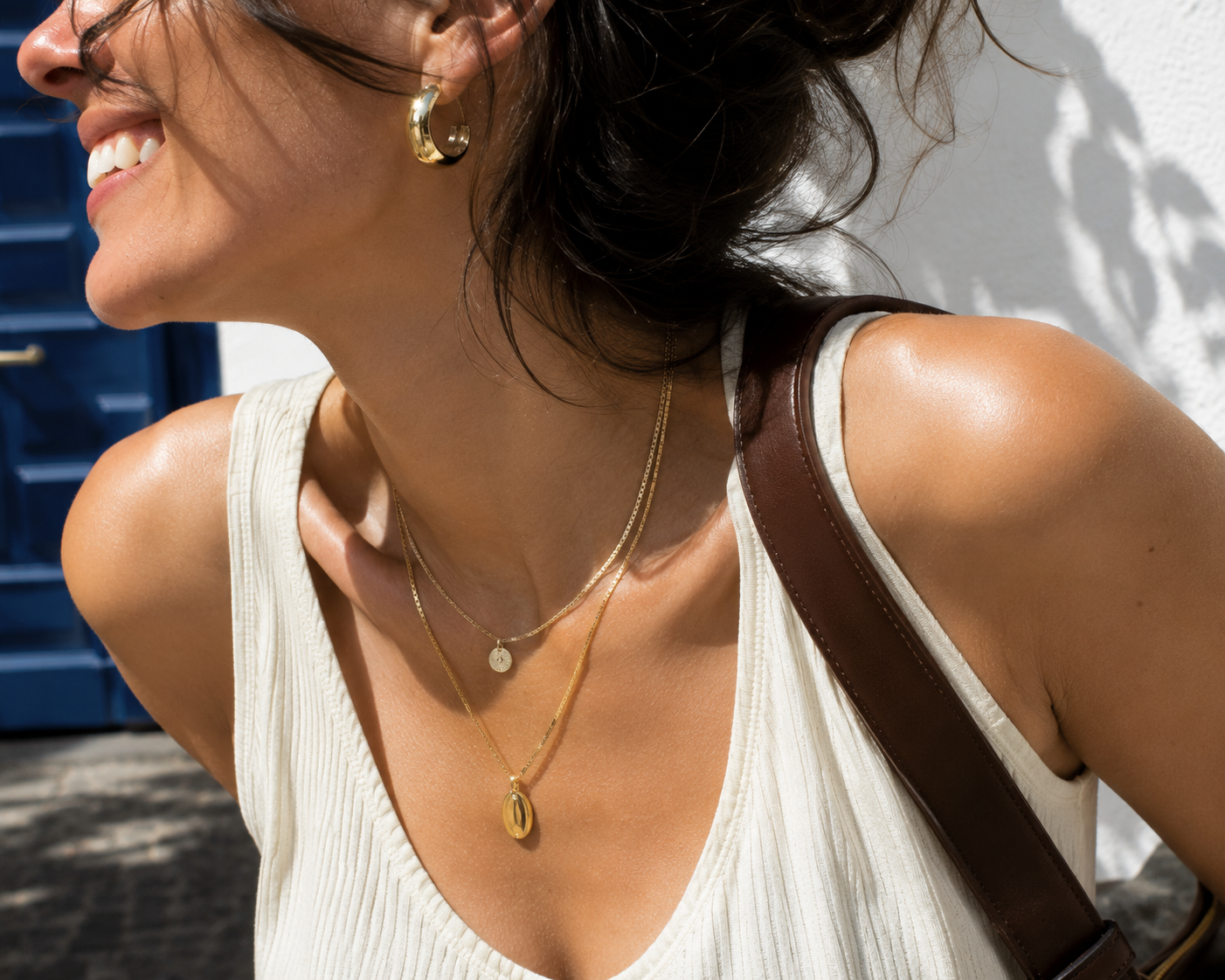
Everyday jewelry that doesn’t tarnish sounds like a simple ask — until you’re standing in front of a wall of identical-looking gold hoops with no way to tell which ones will still look good in six months. The truth is that “gold-toned” and “gold” are doing very different jobs, and the gap between them is exactly where most jewelry disappointments happen: the piece looks perfect on day one, then starts showing a dull, brassy patch behind the ear or a faint green line on the finger by week three.
The good news is that telling the difference doesn’t require a gemology degree. It comes down to three material categories, a couple of honest tradeoffs, and knowing which questions actually matter before you add something to cart. Below, six pieces across solid gold, gold vermeil, and gold-plated stainless steel — each one a genuine, fetch-verified product, not a stock photo placeholder — organized so you can match the material to how hard you actually plan to wear it.
Three material categories genuinely resist everyday wear-and-tear, and they behave differently enough that it’s worth knowing which is which before you shop.
Nordstrom fashion director Linda Cui Zhang has pointed to exactly this shift for 2026 — a return to wear-forever pieces you put on and rarely take off, rather than jewelry reserved for special occasions.
Solid gold (10k or 14k) doesn’t tarnish, full stop — gold is chemically inert, so there’s no plating to wear through. The tradeoff is price. 10k is the more budget-friendly solid-gold option, with more alloy mixed in for extra durability, while 14k leans slightly richer in color.
Gold vermeil is a thick layer of real gold — by U.S. regulation, at least 2.5 microns, plated over sterling silver. It’s a meaningfully different product from ordinary gold plating: the layer is thick enough to hold up to years of normal wear rather than months, though it will eventually show its silver base if worn hard enough for long enough.
Gold-plated stainless steel is the newer entrant, and it’s genuinely changed what’s possible at a lower price point. A 316L stainless steel base doesn’t corrode or discolor on its own, and a gold layer plated onto it holds up well to water and daily wear — noticeably better than traditional gold-plated brass, which tends to show wear at the plating layer regardless of brand claims. It’s not identical to solid gold or vermeil in look or feel, but it’s a legitimate everyday option, not a compromise pretending to be something else.
A second, related but distinct thing to know: tarnish resistance and hypoallergenic safety aren’t the same question, even though they often travel together. Nickel-free 316L stainless steel and titanium are usually the safer picks for sensitive skin, regardless of how tarnish-resistant a piece is. If you’ve had reactions to costume jewelry before, that’s the spec to check first.
If there’s one piece worth spending on, it’s earrings you genuinely never take off — nothing touches skin more constantly. A small, solid-gold huggie hoop with a secure clicker closure is about as close to “set it and forget it” as jewelry gets.
A thin solid-gold chain is the piece that quietly does the most work in a jewelry rotation — worn alone on a plain tee, layered under a sweater, or stacked with a pendant. Because it’s solid gold rather than plated, it holds up to being worn literally every day without a second thought.
10k solid gold, 16–18″ and 20–22″ length options, 0.95mm thickness.
Rings take more physical abuse than almost anything else in a jewelry box — hand-washing, typing, gym bags. A simple solid-gold band skips the plating-wear problem entirely, which matters most on the piece you’re least likely to remember to remove.
For a bolder shape without the solid-gold price tag, gold vermeil is the honest middle option — real gold, just not solid through. A domed, sculptural huggie is a good showcase for it: the thickness of vermeil plating actually shows in a piece with more surface area.
We’ve made a similar case before in our women’s quiet luxury capsule wardrobe roundup — jewelry earns its “investment” label from how it’s made, not from its price tag.
Not every piece needs to be a long-term investment, especially for a trend shape you might not still love in two years. A gold-plated stainless steel chain lets you try a current silhouette — right now, a fine snake chain — without the vermeil or solid-gold price commitment.
14k gold-plated 316L stainless steel, 1.28mm width, adjustable 16″+2″ length.
A bracelet gets more incidental water exposure than almost anything else you wear — hand-washing, showering, the ocean. A stainless steel base genuinely helps here, since it isn’t the base metal that eventually dulls the way brass does; it’s just the gold layer on top, and a well-plated one holds up.
14k gold-plated stainless steel, 8mm basket-weave link, 6″ and 7″ sizes.
It’s real, but it depends on the metal doing the actual work. Solid gold and gold vermeil resist tarnish because there’s genuinely little to nothing to wear through; gold-plated stainless steel resists it better than older gold-plated brass because the base metal itself doesn’t corrode, even though the gold layer on top can eventually thin with heavy wear.
Vermeil is a legal, regulated term in the U.S. — it requires at least 2.5 microns of real gold over sterling silver. Ordinary “gold-plated” jewelry has no minimum thickness requirement and is often plated over brass, which is why vermeil tends to hold its color noticeably longer.
Solid gold and properly plated stainless steel generally handle water fine for daily wear. Vermeil can, too, but tends to do best with occasional drying-off rather than constant water exposure, since moisture trapped against the silver base over time can eventually affect the plating.
Usually, yes — 316L surgical-grade stainless steel is nickel-free and one of the more skin-safe options, alongside titanium. If you’ve reacted to costume jewelry before, that’s the spec worth checking on the product page rather than assuming from the finish alone.
Put jewelry on last (after lotion, perfume, and hairspray) and take it off first before swimming in chlorine or salt water for extended periods. None of that is unique to these pieces — it’s just standard care that extends any metal’s finish, tarnish-resistant or not.
We research and select every product featured on Isle Theory. Our recommendations reflect independent editorial judgment, not paid placement.
No spam. Unsubscribe anytime.