Isle Theory Editorial Team
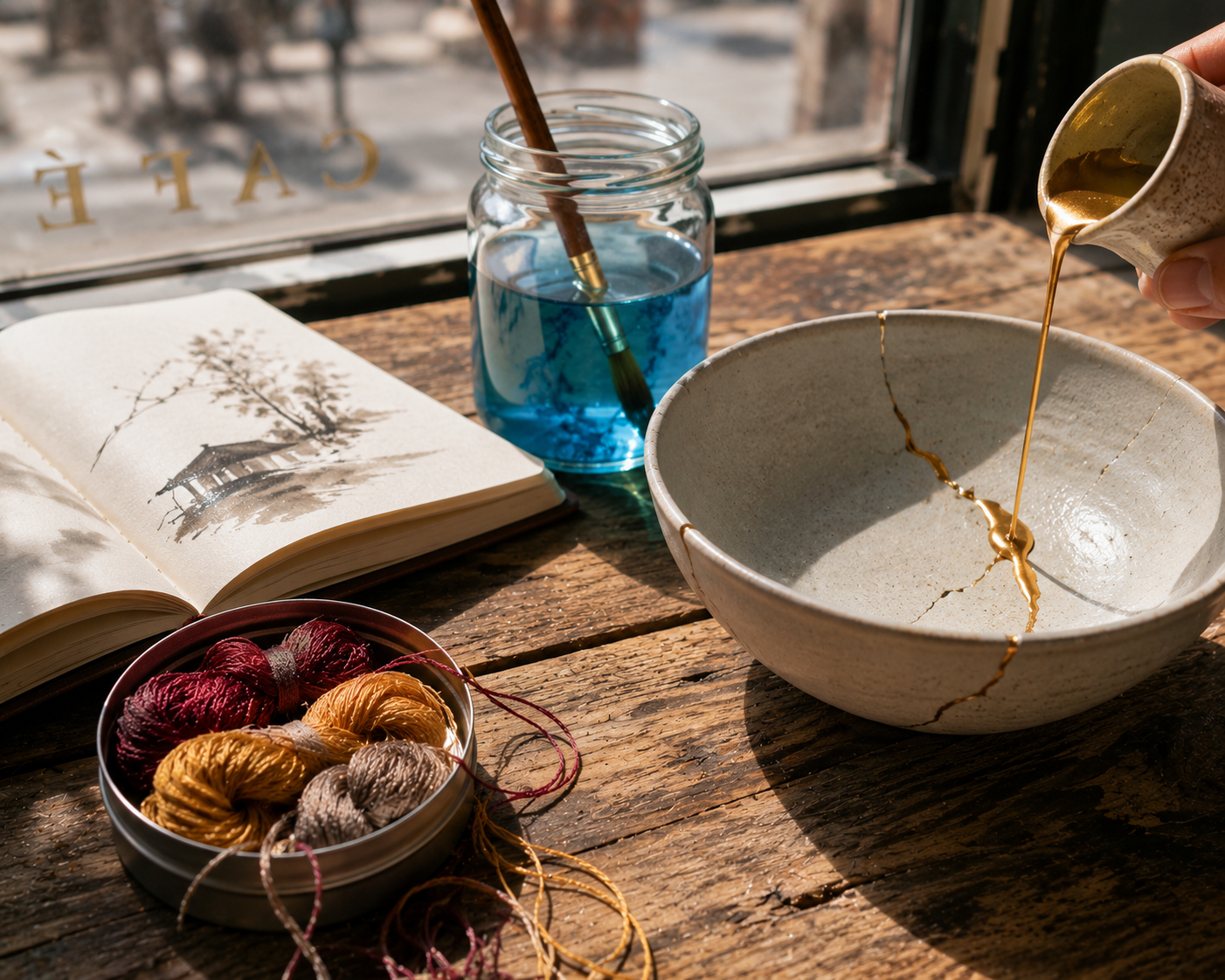
Everyday rituals as art is the quiet thesis running through some of the most interesting corners of the slow living movement right now — the discovery that an ordinary task, done with real attention, can become a genuine creative practice. Not a hobby squeezed into a spare hour. Not content made for an audience. Something closer to a daily discipline that happens to also produce something beautiful.
Four practices show this clearest: a repair movement that refuses to hide its stitches, a centuries-old Japanese art of mending pottery with gold, a three-page writing habit that predates the internet by decades, and a global community of people who draw the cities around them instead of photographing them. None of these started as a slow living movement. All of them have been absorbed into it, because they share the same shape — small, repeated, unhurried, and genuinely creative.
Most slow living advice focuses on subtraction — fewer commitments, less noise, a slower pace. These four practices point somewhere more interesting: addition. Each one asks a person to add a small, repeated act of making into an ordinary day, and to let that act stay visibly imperfect rather than polished for an audience. That combination — repetition plus visible imperfection — is what separates a ritual from a routine, and a ritual from a finished piece of art hung on a wall.
For most of the 20th century, mending clothes meant making the repair disappear — matching thread, hidden stitches, no trace that anything had ever torn. Visible mending, popularized by fashion historian Kate Sekules and Dutch sewer Tom van Deijnen (known in stitching circles as Tom of Holland), does the opposite. Repairs are done in contrasting thread, bold color, or deliberately decorative stitching, so the mend becomes the most noticeable part of the garment rather than the part everyone tries to hide.
The technique traces back to sashiko, a Japanese hand-stitching tradition originally used to reinforce and repair work clothing. Sekules’s #MendMarch hashtag and groups like the Edinburgh Street Stitchers have turned it into something communal — people mending in public, in groups, teaching each other stitch by stitch. The ritual isn’t really about the sweater. It’s the twenty or thirty unhurried minutes spent noticing a garment closely enough to repair it by hand.
Kintsugi is the traditional Japanese art of repairing broken pottery by rejoining the pieces with lacquer dusted in gold. Rather than disguising the crack, kintsugi highlights it — the break becomes a gold seam running across the piece, visible from across a room. Community workshops built around the practice have spread well beyond Japan, often paired explicitly with meditation and framed as a shared act of restoration rather than just a craft technique.
What makes kintsugi land as ritual rather than just technique is the pace it forces. The lacquer needs time to cure between steps, so a piece can’t be rushed to completion in one sitting. A person has to return to it, sit with the break for a while, and finish it slowly across several sessions — which is close to the exact opposite of how most people currently treat anything broken.
Julia Cameron introduced morning pages in her 1992 book The Artist’s Way: three handwritten pages, done first thing in the morning, about anything at all, with no editing and, for the first several weeks, no rereading. It has since become one of the most widely repeated creativity rituals in circulation, credited by writers, filmmakers, and complete beginners with unlocking work that had been stuck for years.
The pages themselves are rarely art in any conventional sense — Cameron has described them as closer to a cleaning process than a finished piece of writing. The ritual is the art: the same three pages, the same early hour, repeated daily until the inner editor that blocks most creative work quiets down enough to let something real onto the page.
Urban Sketchers began in 2007 when Seattle journalist Gabriel Campanario started an online group for people who draw the cities they live in and visit, always from direct observation, never from a photo. It’s now a global nonprofit with local groups meeting in cities worldwide, built around a short manifesto: draw on location, tell the story of the surroundings, stay truthful to the scene.
The rule against working from photos is the whole ritual. A photo can be taken in a second and studied later; a sketch demands twenty uninterrupted minutes of actually looking at a street corner, a café, a stranger’s coat. The Urban Sketchers manifesto puts it plainly — the practice is less about the finished drawing than about the act of paying attention long enough to make one.
Everyday rituals as art isn’t a lifestyle overhaul aimed at people with hours of free time. Each of the four practices above started as one small, repeatable act — a hand-stitched patch, three pages, a pocket sketchbook, a single glued seam. None of them require a studio, a course, or a total redesign of a morning.
The through-line across every version of everyday rituals as art here is smaller than it looks: choose one ordinary object or ten unclaimed minutes, return to it on purpose, and let the result stay visibly unfinished rather than polishing it into something presentable. That’s the whole practice. The art is in the repetition, not the result.
Everyday rituals as art means treating a small, repeated task — mending a hem, writing three pages before coffee, sketching from a café window — as a genuine creative practice, not just a chore to get through. The ritual itself is the art, not just what it produces.
No. Visible mending, morning pages, and urban sketching are all explicitly built for beginners — the imperfection is part of the practice, not a barrier to starting. Kintsugi has a steeper learning curve because of the lacquer work, but most community workshops are designed for complete beginners with no prior pottery or repair experience.
Most of the practices above are built around ten to thirty minutes, done regularly rather than in a single long session. Morning pages take roughly the time it takes to write three handwritten pages; a mending session or a sketch can be as short as twenty minutes.
Not quite. Slow living is the broader philosophy of living with more intention and less rush; these four rituals are specific creative practices that have become closely associated with that philosophy because they share its pace and values, not because they define it.
We research and select every product featured on Isle Theory. Our recommendations reflect independent editorial judgment, not paid placement.
No spam. Unsubscribe anytime.