Isle Theory Editorial Team
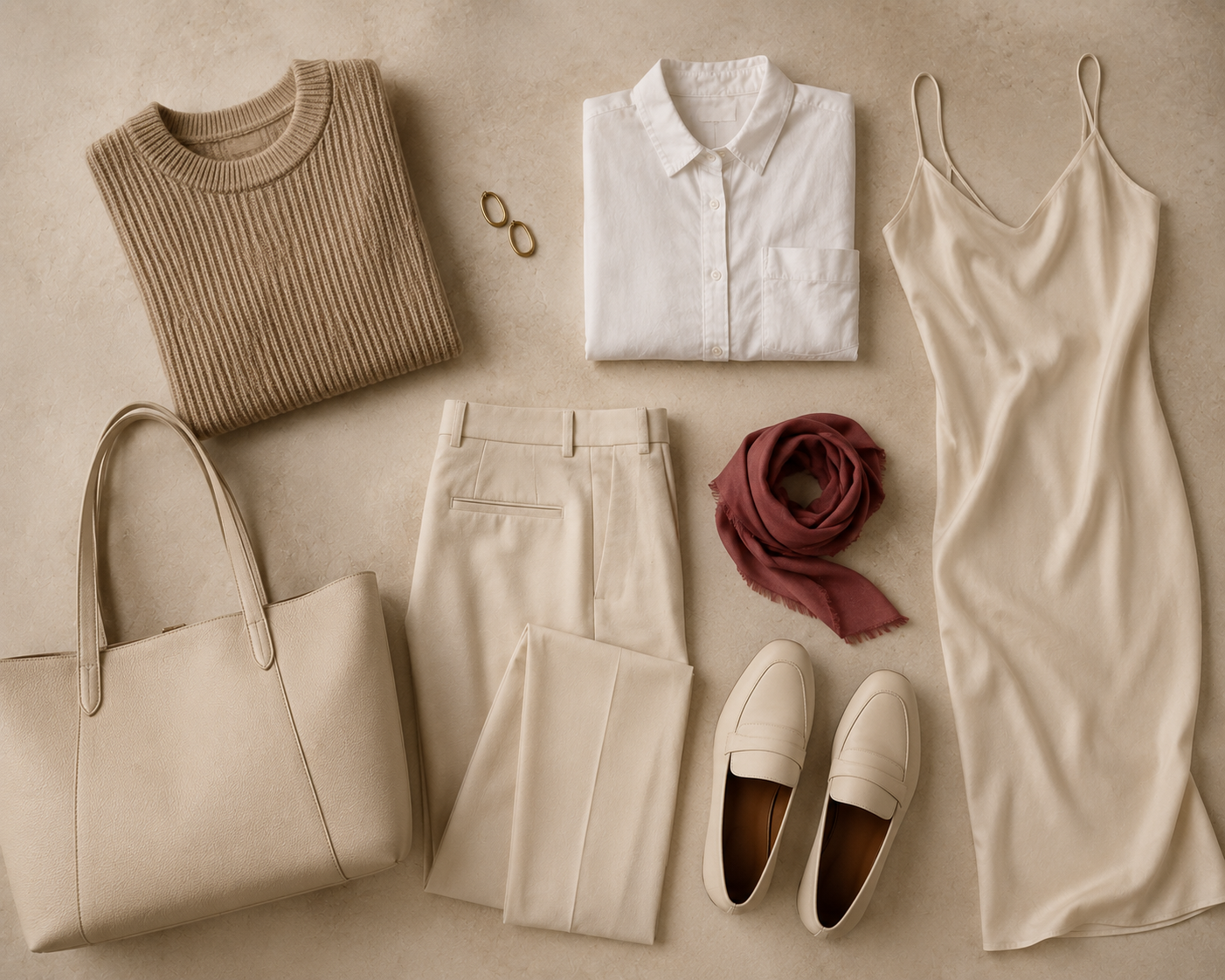
Learning how to build a capsule wardrobe usually starts with a number — 33 items, 37 items, 10 core pieces — before anyone explains why the number matters less than what’s actually in it. A capsule wardrobe isn’t a smaller version of a regular closet. It’s a working system: a limited set of pieces chosen specifically because they combine with each other, so that getting dressed stops being a daily negotiation with a closet full of things that don’t quite go together. This guide walks through where the idea came from, how many pieces you actually need, how to choose a color foundation, and how a capsule holds up once the season changes — without pretending there’s one correct number everyone should hit.
The term “capsule wardrobe” was coined in the 1970s by Susie Faux, who ran a London boutique and used it to describe a small edit of seasonless, interchangeable pieces she sold to her clients. The idea reached a much wider audience in 1985, when American designer Donna Karan built her “Seven Easy Pieces” collection around the same logic — a handful of garments designed to be worn in dozens of combinations rather than as fixed outfits. More recently, writer Courtney Carver’s Project 333 (started in 2010) turned the concept into a specific challenge: 33 items, worn for three months, with underwear, sleepwear, and workout clothes exempted from the count.
None of these are competing systems so much as the same idea applied with different levels of structure. Project 333 is useful if you want a hard boundary and a built-in deadline to reassess. A looser framework — the one this guide uses — is better if you’d rather build something that evolves with you instead of resetting every season.
The instinct with any new system is to go buy the “right” pieces. With a capsule, that’s backward. Most people already own a working capsule — it’s just buried inside a closet full of things that don’t get worn.
The first real step is laying out everything you own and separating it into three groups: what you reach for constantly, what you wear occasionally but would miss, and what hasn’t been worn in the last year. That first pile — the pieces you already reach for — will usually share more in common than you’d expect: a similar color range, a consistent fit, fabrics that feel right against your body. Those shared qualities aren’t a coincidence. They’re your actual style preferences, as opposed to the ones you think you have. Building from that pile, rather than from a blank slate, is the difference between a capsule that gets worn and one that gets abandoned by week three.
A capsule works because most of the pieces in it can be worn together without a second thought, and that’s almost entirely a function of color, not garment type. The standard approach is to build around two or three neutrals — black, navy, camel, gray, cream, and taupe are the most common — and then add one or two accent colors that you already know you wear and enjoy.
The test worth applying to every piece, whether it’s already in your closet or something you’re considering buying: does it work with at least three other things you own? A piece that only pairs with one other item is an outfit, not a capsule piece, and it’s usually the first thing that ends up unworn six months later.
There’s no single correct piece count, and most of the frameworks that promise one are more useful as starting points than rules. A few reference points, pulled from the most commonly cited methods:
The math behind why a small number of pieces produces far more outfits than it looks like it should: 4 tops and 3 bottoms in a shared color family isn’t 7 items, it’s 12 possible top-and-bottom pairings before layers or accessories are added. That multiplication is the entire point of the color-foundation step above — it’s what turns a small pile of clothes into a wardrobe that doesn’t feel small.
None of these numbers are a test to pass. The point of learning how to build a capsule wardrobe isn’t hitting a specific count — it’s making sure everything in your rotation earns its place.
A capsule wardrobe isn’t a one-time project — it’s a system that gets revisited, not rebuilt, as the seasons change. The core neutrals and the pieces that work across seasons (a good pair of trousers, a white shirt, a versatile flat) usually stay in place year-round. What rotates is the layer on top of that foundation: heavier knits and outerwear swap in for colder months, lighter fabrics and shorter sleeves swap in for warmer ones, with the off-season pieces moved out of daily rotation rather than discarded.
The practical version of this: at each seasonal shift, pull three questions on every piece currently in rotation — did I actually wear this last season, does it still fit the way I want it to, and does it still pair with at least three other things I own. Anything that fails more than one of those questions is a candidate to retire, not necessarily replace.
A few patterns show up consistently in capsule wardrobes that don’t end up working:
If quiet luxury basics and clean color palettes are the direction you’re drawn to, our breakdown of a twelve-piece women’s investment capsule shows this framework applied to actual pieces and price points.
There’s no fixed number — most frameworks land between 20 and 40 pieces per season, with 33 (Project 333) and 20-piece starter formulas being the two most commonly cited starting points. The count matters less than whether every piece works with several others.
The short version of how to build a capsule wardrobe is: audit what you already wear before buying anything, choose two or three neutral colors as your foundation, then fill genuine gaps rather than replacing a working wardrobe from scratch.
The underlying logic — fewer pieces that combine well beats more pieces that don’t — applies regardless of how minimalist someone’s overall lifestyle is. A capsule can sit at 20 pieces or 50; the structure is the same either way.
Most guidance points to a seasonal check-in rather than a full rebuild — reassessing what’s been worn, what still fits, and what’s earned its place, then rotating in season-appropriate layers on top of a foundation that mostly stays constant year-round.
We research and select every product featured on Isle Theory. Our recommendations reflect independent editorial judgment, not paid placement.